
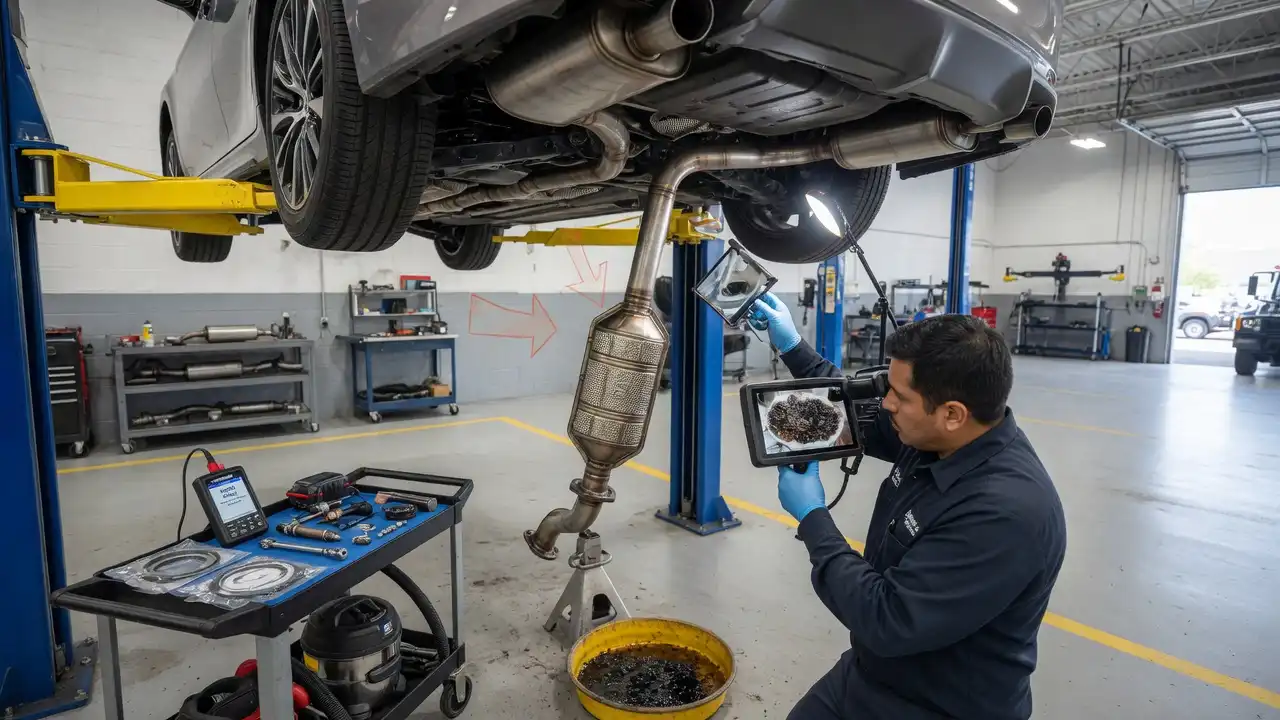
A sluggish car that stalls at stoplights and struggles up hills often points to one part: a blocked exhaust system. Learning the symptoms of a clogged catalytic converter early can save you money and keep your check engine light from becoming a bigger repair.
Key Highlights
- Watch for poor acceleration, rotten-egg smell, and a lit check engine light as the first warning signs.
- A catalytic converter diagnostic test measuring backpressure confirms the problem before you spend on parts.
- Replacement costs vary widely between OEM vs aftermarket catalytic converter options, so compare before you buy.
Check Also: Fix the Durango Racetrack Tail Light Lawsuit Issue
What a Clogged Converter Actually Does
Your catalytic converter turns harmful exhaust gases into safer compounds. When its internal honeycomb melts or fills with carbon, exhaust cannot escape. That restriction, called catalytic converter backpressure, chokes the engine and cuts power.
Our mechanics noted that most clogs trace back to a deeper issue, such as an oil leak, a rich fuel mixture, or a failing oxygen sensor. Fixing only the converter without finding the root cause often leads to a repeat failure.
Top Symptoms of a Clogged Catalytic Converter
If you are dealing with this engine issue, the symptoms of a clogged catalytic converter usually appear together rather than alone. The table below breaks down what each sign means and what may be driving it.
| Symptom | What You Notice | Likely Cause |
|---|---|---|
| Poor acceleration | Engine hesitates, feels “held back” under load | High backpressure restricting exhaust flow |
| Rotten-egg smell | Sulfur odor from the tailpipe | Converter not processing sulfur compounds |
| Check engine light | Codes P0420 or P0430 stored | Reduced converter efficiency |
| Rough idle / stalling | Engine dies at stops | Exhaust unable to clear the cylinders |
| Reduced fuel economy | More frequent fill-ups | Engine working harder against restriction |
| Excess heat under car | Floor or exhaust glowing hot | Internal melting and blockage |
| Failed emissions test | High readings at inspection | Converter no longer cleaning gases |
Key takeaway: One symptom may point elsewhere, but three or more together strongly suggest a restricted converter.
Why a Blocked Converter Matters for Safety
A restricted exhaust does more than sap performance. According to NHTSA vehicle safety guidance, a stalling engine in traffic raises crash risk. The EPA also treats a functioning converter as a legal emissions requirement, which is why a failed emissions test can keep your car off the road.
We recommend treating these warning signs as urgent rather than optional. Ignoring them can damage the engine and drive up repair bills.
Diagnostic Steps: Confirm Before You Replace
Guessing is expensive. A proper catalytic converter diagnostic test confirms the clog before you pay for a new part. Our experience in the garage suggests following these steps in order.
| Step | Test | Tool Needed | What It Tells You |
|---|---|---|---|
| 1 | Read trouble codes | OBD-II scanner | Flags P0420 / P0430 efficiency codes |
| 2 | Measure backpressure | Backpressure gauge | Over 3 psi at idle often signals a clog |
| 3 | Vacuum test | Vacuum gauge | Dropping vacuum at steady RPM points to restriction |
| 4 | Temperature check | Infrared thermometer | Inlet hotter than outlet suggests blockage |
| 5 | Tap test | Rubber mallet | Rattle means broken internal substrate |
Tools you may want on hand:
- OBD-II scanner
- Backpressure or vacuum gauge
- Infrared thermometer
- Basic wrench and jack set
- Safety glasses and gloves
According to Cadillac and GM factory service manuals, backpressure readings should be checked against the specific engine’s published spec, since thresholds differ by model.
Check Also: Ford F-150 Oil Consumption Lawsuit: What Owners Must Know
When to Take It to a Mechanic
Some checks are safe for a driveway. Others need a lift and trained hands. Our technicians observed that misreading a hot exhaust causes burns and bad diagnoses.
- The check engine light returns after a reset.
- Backpressure readings exceed the manufacturer spec.
- You smell fuel or see visible exhaust smoke.
- The car stalls repeatedly in traffic.
- Your state emissions test fails a second time.
Repair Cost Breakdown
Once you confirm the symptoms of a clogged catalytic converter, cost becomes the next question. Prices depend on your vehicle, the converter type, and local labor rates.
| Repair Scope | Parts | Labor | Estimated Total |
|---|---|---|---|
| Aftermarket converter (economy car) | $150 – $500 | $70 – $200 | $220 – $700 |
| OEM converter (mid-size sedan) | $500 – $1,200 | $150 – $300 | $650 – $1,500 |
| Luxury / performance vehicle | $1,000 – $2,500 | $200 – $400 | $1,200 – $2,900 |
| Related repair (O2 sensor) | $50 – $250 | $50 – $150 | $100 – $400 |
Costs are estimates and may vary by region, emissions rules, and part availability. CARB-compliant converters, required in states like California, often cost more.
OEM vs Aftermarket Catalytic Converter
Choosing between an OEM vs aftermarket catalytic converter affects price, fit, and warranty. Neither is always the right answer. The trade-offs below can guide the decision.
| Factor | OEM Converter | Aftermarket Converter |
|---|---|---|
| Price | Higher | Lower |
| Fit | Exact factory match | May need minor adjustment |
| Emissions compliance | Meets original spec | Verify CARB / EPA approval |
| Warranty | Often longer | Varies by brand |
| Availability | Dealer or supplier | Widely stocked |
| Best for | Newer or leased vehicles | Older, out-of-warranty cars |
Key takeaway: OEM suits newer vehicles under warranty. A quality aftermarket unit can serve older cars well, as long as it meets your state’s emissions rules.
Warning Signs vs. Solutions
This quick reference pairs each symptom with a practical next move.
| Warning Sign | Recommended Action |
|---|---|
| P0420 / P0430 code | Run a full catalytic converter diagnostic test |
| High backpressure | Inspect for internal blockage; plan replacement |
| Failed emissions test | Verify converter and O2 sensors before retest |
| Rotten-egg smell | Check fuel mixture and converter function |
| Stalling at idle | Tow rather than drive; avoid engine damage |
Common Mistakes Drivers Make
Our experience in the garage suggests these errors cost owners the most money and time.
- Replacing the converter without fixing the root cause, such as a rich fuel mixture.
- Buying a non-CARB-compliant part in a state that requires one.
- Clearing the check engine light to pass inspection instead of repairing.
- Ignoring early symptoms of a clogged catalytic converter until the engine stalls.
- Skipping the backpressure test and guessing at the diagnosis.
Check Also: Kia Seltos Soul Recall NHTSA Audit Facts
Next Steps
The symptoms of a clogged catalytic converter rarely fix themselves. Early diagnosis, an honest cost comparison, and the right part choice help you avoid a repeat repair. Start with a scan tool and a backpressure reading before you buy anything.
If you are unsure about the results, bring your vehicle to our shop for a full catalytic converter diagnostic test. Tell us what codes you are seeing and how the car behaves under load, and we can help you plan the most sensible repair.



One Comment